
How fast can Chino Hills Porta Pros respond to a disaster?
Emergency response moves differently than a planned event rental. There's no three-week lead time, no waiting on a landscaper's schedule. When a shelter opens or a work crew needs sanitation on short notice, emergency porta potty rental is built around same-day and next-day delivery whenever the fleet allows it. A standard unit needs roughly the same footprint whether it's going to a church parking lot or a downed-power-line staging zone: about 44 by 48 inches on the ground and 92 inches tall, so it fits tight urban lots and rural pull-offs alike. For crews staying on-site for days, standard porta potty rental covers the baseline, and if the recovery drags into weeks, monthly porta potty rental options keep costs from stacking daily rates. Disaster response also often means feeding, hydrating and washing down crews working with debris, ash or chemical residue, which is where handwashing counts as much as toilets. Coordination with the Red Cross or a city-run shelter typically covers headcount, but the same math OSHA uses for job sites is a reasonable starting point: OSHA 1926.51(c) sets 1 toilet for 20 workers or fewer, scaling up from there. Chino Hills sits inland from the coast and can see both fire-driven evacuations and seasonal flooding in canyon-adjacent neighborhoods, and either scenario can put a shelter, a command post or a debris yard in a spot with no working restroom for days. That's the gap this equipment fills.
What sanitation equipment works best for emergency and shelter sites?
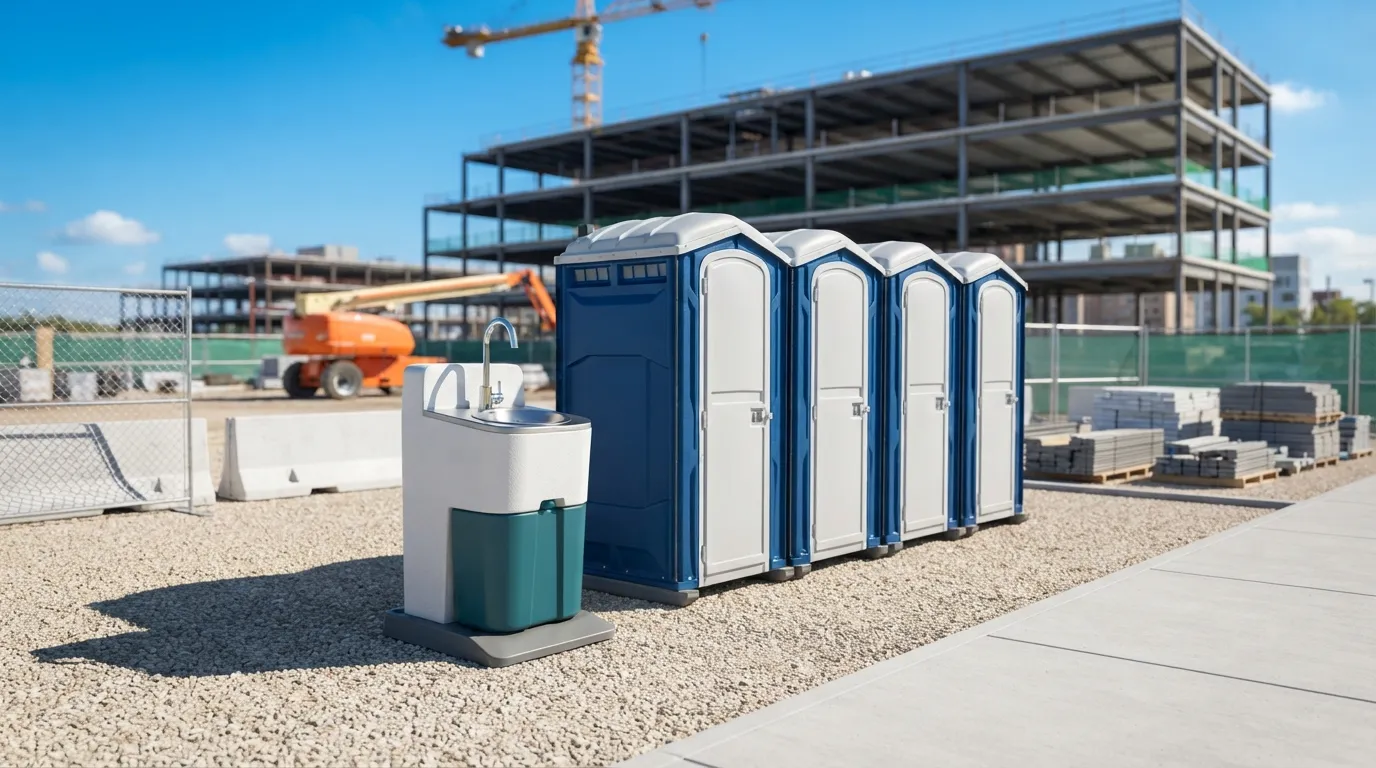
Different disasters call for different gear, and pairing the wrong unit with the situation slows everyone down. A shelter housing families for a week needs more than a bare toilet: it needs handwashing, and ideally something closer to a real restroom. Portable restroom rental units and restroom trailer rental options both work, but the trailer makes sense when a site expects to run for more than a few days and needs climate control or higher stall counts, like an 8 stall restroom trailer at a large shelter. Smaller command posts or single-crew sites do fine with a porta john rental and a nearby handwashing station rental. Handwashing isn't optional where crews are handling debris, ash, or anything treated with cleaners or pesticides during cleanup: OSHA 1926.51(f)(1) requires washing facilities specifically where workers apply paints, coatings, herbicides or insecticides, and general industry rules under 29 CFR 1910.141(d)(2) call for soap and towels, not just sanitizer. Debris removal itself usually means roll-off dumpster rental, and after a major storm or fire a 30 yard dumpster rental or 40 yard dumpster rental clears downed limbs and ruined drywall fast. If flooding has knocked out a septic system, emergency septic service and holding tank rental options bridge the gap until the tank's repaired. Sites also sometimes need temporary fence rental to keep evacuees or the public out of a damaged structure while cleanup runs.
What does emergency sanitation cost during a disaster?
Pricing during a disaster still follows normal rental structures, just compressed into shorter windows. A standard unit runs in the same band whether it's deployed for a shelter or a construction site, and knowing the range ahead of time helps a shelter coordinator or facilities manager budget fast.
| Unit | Day | Week | Month |
|---|---|---|---|
| Standard unit | $100 - $350 | $130 - $500 | $125 - $325 |
| ADA unit | $200 - $400 | $240 - $400 | -- |
| Dumpster | $51 - $112 | $426 - $778 | $800 - $2400 |
Delivery fees generally run $100 to $500 for a single trip, and a service fee for pump-outs or restocking during an extended deployment lands between $100 and $300 a day. Full breakdowns live on porta potty rental cost and porta potty rental per day if a shelter needs to plan a multi-week budget. For accessibility, ADA Standards section 213.2 requires at least 5 percent of a cluster of units to be accessible, never fewer than one, which matters when a shelter is serving elderly or disabled evacuees. Chino Hills sites near Eastvale, about 13.7 miles east, sometimes pull from the same regional stock during a widespread event, so booking early matters when demand spikes across more than one city at once.
Do I need a permit for emergency portable toilets in Chino Hills?
Placement in the public right of way needs confirming with the city; that rule isn't settled here, so check with Chino Hills before setting units on a street or sidewalk. On private property, most emergency deployments move ahead without a permit delay. See porta potty permit requirements for more.
How many toilets does a shelter need?
It depends on headcount and hours of operation, but OSHA's ratio under OSHA 1926.51(c) is a workable baseline: 1 unit per 20 people, scaling up from there. A shelter running 24 hours may need more given constant use. See how many porta potties do i need.
Can you deliver during an active evacuation?
Access depends on road closures and safety zones set by emergency management. Chino Hills Porta Pros will deliver as close as conditions allow and coordinate timing once roads reopen. Call ahead so delivery can be staged the moment access clears.
What if the disaster site has no water or power?
Portable units don't need either. Standard toilets are self-contained with a 60 to 70 gallon holding tank, and handwashing stations carry their own water supply, so a dead grid doesn't stop deployment.
How long can equipment stay on-site?
As long as the recovery takes. Many disaster deployments run weeks or months, and monthly porta potty rental pricing keeps extended stays affordable compared to renewing daily rates.
Next step
Get a delivery date
Tell us the address, the dates and the headcount. We size the order and confirm the route.